Installation Guides, L53


| Load Capacity | For softwoods and fast-drying hardwoods (Pine or Poplar) 300 - 400 BF For slow-drying hardwoods (Oak) 1,000 BF |
| Nominal Water Removal Rate | 60 lbs/day |
| Drying Time | 4/4 Green Pine - 80% to 8% in approximately 12 days. 4/4 Green Oak - 65% to 8% in approximately 35 days. |
| Drying Temperature Range | 70°–120° F (21°–49° C) |
| Heat Treating Capability | Yes, up to 160° F (71° C) |
| Compressor | 1/2 HP |
| Internal Blower Motors | 2 internal fans; 40 watts each, 525 CFM |
| Auxiliary Heat | 1,000 Watts |
| Over Temperature Vents | One power vent system included (includes exhaust and intake) |
| Power Requirements | 120V, 60 Hz, Dedicated 15A Required. |
| Shipping Weight | 150 lbs |
| Dimensions (H × L × W) | 37½" × 22" × 14½" (base unit only) |
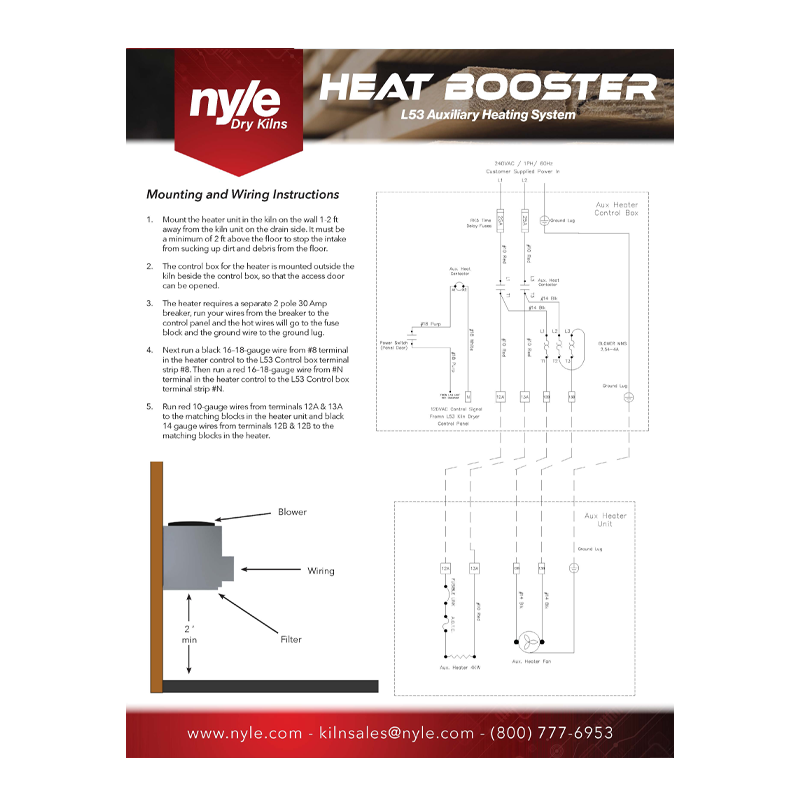
Your L53 Auxiliary Heat Booster should have come with an instruction sheet. If you didn't receive one or misplaced it, you can find it here.
For your L53 kiln, you should follow these steps for mounting the Dry Bulb and Wet Bulb sensors:
Dry & Wet Bulb Sensor Installation:
Make sure to follow the specific installation instructions for securing the sensors and ensuring they are positioned correctly for accurate readings.
The L53 kiln chamber can have either a concrete floor or a wood floor. However, for the best results, a concrete floor with insulation installed underneath is recommended. If you choose to use an existing concrete floor, the insulation may be omitted, but the concrete must not extend beyond the kiln walls.
If you opt for a wood floor, it must be built according to construction guidelines. If you need more specific construction guidelines, feel free to reach out, and we can provide them.
The L53 kiln does not specifically require positioning on a stand; it can be placed directly on the floor of the chamber. However, it is essential to ensure that the installation meets any local building codes and safety regulations.
The L53 kiln requires a power supply of 120V, 60 Hz, with a dedicated 15A circuit. It can be run on solar power or a generator, provided that the power output meets these specifications.
Make sure that the solar power system or generator can consistently supply the necessary voltage and amperage for optimal operation.
To properly route the water from the L53 kiln, you should connect an appropriate length drain hose to the dehumidifier's drain spout. The drain must have a trap to prevent backflow.
Make sure to drill a hole in the back wall of the kiln for the drain tube to exit, ensuring that the drain tube has proper flow out of the kiln. Additionally, the wall opening should be sealed around where the drain hose extends outside of the chamber.